
Tracking Triggers
Do you sometimes react in the moment, and later regret what you said or did?
When the same people or situations keep triggering you, it can be hard to see how things could unfold differently. Tracking Triggers: From Reactivity to Responsiveness offers a practical path to understanding your reactions and developing greater freedom to choose how you respond.
Drawing on the art of wilderness tracking, John Ford invites you to follow the signs within your reactions, discover what needs your attention, and practice responding with greater awareness and choice, even when someone else is triggered.
“In his well-written and soulful book, John provides a clear pathway for readers to understand what triggers us and leads us into conflict. Along the way, practical exercises strengthen our ability to move from reactivity to a steady, responsive presence.”
Cinnie Noble, Author of Conflict Management Coaching: The CINERGY Model and Conflict Mastery: Questions to Guide You

Understand Your Reactions
Why do the same people or situations keep triggering you? Why does a reaction sometimes feel bigger than the moment?
Your reactions contain meaningful information. Following their tracks can help you recognize familiar patterns, explore the stories you tell yourself, and understand the feelings and needs beneath them.
Tracking Triggers invites you to approach these experiences with curiosity and care. What takes you off balance can become a starting point for greater self-understanding.

Practice a Different Response
Catch the early signs. Find your way back to center. Say what matters with greater clarity.
Tracking Triggers introduces the Fifth Way: Recognize, Regulate, Name, Feel & Act Anew, and Respond. Through stories, reflection, and practical exercises, you’ll learn to distinguish what happened from the story around it, understand your feelings and needs, and choose your next step.
The practice also invites you to meet what remains unresolved, so familiar triggers can gradually lose some of their power.
You may still get triggered. You can develop greater confidence in what to do next.
Continue with Community
You don’t have to explore your reactions alone—or have everything figured out before you begin.
Inner Trackers brings together people curious about triggers, relationships, and responding with greater awareness and choice. Join free to receive reflections from John, related articles, and news of opportunities to learn and practice together.
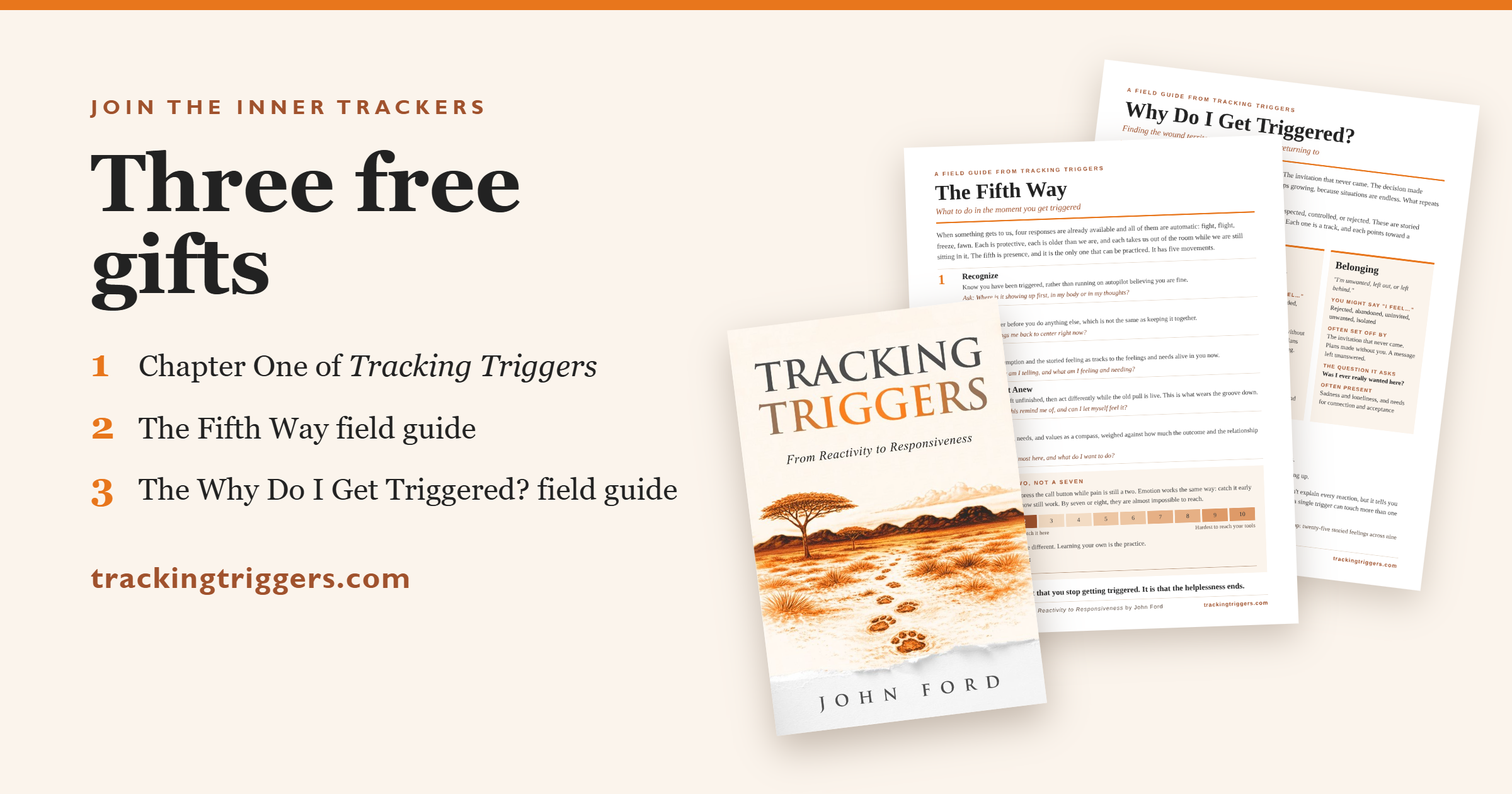
Your welcome gifts include Chapter One of Tracking Triggers and two field guides to help you get started.
About John Ford
For over thirty years, John Ford has taught mediators and practitioners how to track emotional patterns much like wilderness trackers read signs in the landscape, attending closely to what is present rather than forcing premature solutions.
He is a workplace mediator, a negotiation and mediation instructor, and the author of Peace at Work: The HR Manager's Guide to Workplace Mediation. His work draws on decades of practice in organizational conflict, emotional literacy, and relational decision-making.
The approach developed through this work has been distilled into a practical framework for recognizing the body's signals, regulating the nervous system, naming feelings and needs, integrating insight, and choosing conscious response over protective reaction.
This is not theory. It is field-tested practice, shaped by hundreds of mediations, trainings, and real-world conflicts, offered to help people meet moments of reactivity with greater clarity, courage, and care.


FEATURED IN NEWSBREAK
“What appeared at first to be an almost invisible trail became a metaphor for his life's work.”
John Ford Has Spent Nearly 30 Years Learning to Read the Emotional Tracks Behind Conflict